in a randomly generated list of numbers from 0 to 7, what is the chance that each number will occur?

A pseudorandomly generated bitmap.
In common parlance, randomness is the credible or actual lack of pattern or predictability in events.[1] [ii] A random sequence of events, symbols or steps often has no order and does not follow an intelligible pattern or combination. Individual random events are, by definition, unpredictable, just if the probability distribution is known, the frequency of different outcomes over repeated events (or "trials") is predictable.[annotation one] For example, when throwing 2 dice, the issue of any particular scroll is unpredictable, but a sum of vii will tend to occur twice as frequently as 4. In this view, randomness is non haphazardness; it is a measure of uncertainty of an result. Randomness applies to concepts of gamble, probability, and data entropy.
The fields of mathematics, probability, and statistics apply formal definitions of randomness. In statistics, a random variable is an consignment of a numerical value to each possible event of an event infinite. This clan facilitates the identification and the calculation of probabilities of the events. Random variables can appear in random sequences. A random process is a sequence of random variables whose outcomes do not follow a deterministic blueprint, but follow an evolution described by probability distributions. These and other constructs are extremely useful in probability theory and the various applications of randomness.
Randomness is most frequently used in statistics to signify well-defined statistical properties. Monte Carlo methods, which rely on random input (such every bit from random number generators or pseudorandom number generators), are important techniques in science, particularly in the field of computational science.[3] By analogy, quasi-Monte Carlo methods employ quasi-random number generators.
Random pick, when narrowly associated with a simple random sample, is a method of selecting items (often chosen units) from a population where the probability of choosing a specific item is the proportion of those items in the population. For instance, with a bowl containing but ten carmine marbles and xc blue marbles, a random selection machinery would choose a red marble with probability 1/10. Notation that a random selection mechanism that selected 10 marbles from this bowl would not necessarily issue in 1 red and 9 blue. In situations where a population consists of items that are distinguishable, a random selection mechanism requires equal probabilities for any item to exist called. That is, if the selection procedure is such that each member of a population, say enquiry subjects, has the same probability of being chosen, then we tin say the pick process is random.[2]
According to Ramsey theory, pure randomness is incommunicable, especially for big structures. Mathematician Theodore Motzkin suggested that "while disorder is more probable in general, complete disorder is impossible".[4] Misunderstanding this can pb to numerous conspiracy theories.[v] Cristian S. Calude stated that "given the impossibility of truthful randomness, the endeavour is directed towards studying degrees of randomness".[half-dozen] It tin be proven that there is infinite bureaucracy (in terms of quality or strength) of forms of randomness.[6]
History

In ancient history, the concepts of chance and randomness were intertwined with that of fate. Many ancient peoples threw die to determine fate, and this later evolved into games of take a chance. Most aboriginal cultures used various methods of divination to attempt to circumvent randomness and fate.[7] [viii]
The Chinese of 3000 years ago were perhaps the earliest people to formalize odds and chance. The Greek philosophers discussed randomness at length, just only in not-quantitative forms. It was only in the 16th century that Italian mathematicians began to formalize the odds associated with various games of chance. The invention of calculus had a positive affect on the formal written report of randomness. In the 1888 edition of his volume The Logic of Adventure, John Venn wrote a affiliate on The conception of randomness that included his view of the randomness of the digits of pi, by using them to construct a random walk in ii dimensions.[9]
The early on function of the 20th century saw a rapid growth in the formal analysis of randomness, as various approaches to the mathematical foundations of probability were introduced. In the mid-to-belatedly-20th century, ideas of algorithmic information theory introduced new dimensions to the field via the concept of algorithmic randomness.
Although randomness had often been viewed as an obstacle and a nuisance for many centuries, in the 20th century computer scientists began to realize that the deliberate introduction of randomness into computations can be an effective tool for designing better algorithms. In some cases, such randomized algorithms even outperform the all-time deterministic methods.[10]
In scientific discipline
Many scientific fields are concerned with randomness:
- Algorithmic probability
- Chaos theory
- Cryptography
- Game theory
- Information theory
- Pattern recognition
- Percolation theory
- Probability theory
- Breakthrough mechanics
- Random walk
- Statistical mechanics
- Statistics
In the physical sciences
In the 19th century, scientists used the idea of random motions of molecules in the development of statistical mechanics to explicate phenomena in thermodynamics and the backdrop of gases.
According to several standard interpretations of breakthrough mechanics, microscopic phenomena are considerately random.[xi] That is, in an experiment that controls all causally relevant parameters, some aspects of the event however vary randomly. For example, if a single unstable atom is placed in a controlled environment, it cannot be predicted how long information technology will take for the cantlet to disuse—only the probability of decay in a given time.[12] Thus, quantum mechanics does not specify the outcome of private experiments, just but the probabilities. Subconscious variable theories reject the view that nature contains irreducible randomness: such theories posit that in the processes that appear random, properties with a certain statistical distribution are at piece of work behind the scenes, determining the issue in each case.
In biology
The modern evolutionary synthesis ascribes the observed diversity of life to random genetic mutations followed by natural selection. The latter retains some random mutations in the factor pool due to the systematically improved chance for survival and reproduction that those mutated genes confer on individuals who possess them. The location of the mutation is not entirely random however as eastward.g. biologically important regions may be more protected from mutations.[xiii] [14] [fifteen]
Several authors besides claim that development (and sometimes development) requires a specific form of randomness, namely the introduction of qualitatively new behaviors. Instead of the option of i possibility among several pre-given ones, this randomness corresponds to the formation of new possibilities.[16] [17]
The characteristics of an organism arise to some extent deterministically (e.g., under the influence of genes and the environment), and to some extent randomly. For example, the density of freckles that appear on a person'southward pare is controlled by genes and exposure to lite; whereas the exact location of individual freckles seems random.[18]
As far as beliefs is concerned, randomness is important if an animal is to deport in a way that is unpredictable to others. For example, insects in flight tend to move virtually with random changes in management, making information technology difficult for pursuing predators to predict their trajectories.
In mathematics
The mathematical theory of probability arose from attempts to codify mathematical descriptions of chance events, originally in the context of gambling, simply later in connection with physics. Statistics is used to infer the underlying probability distribution of a collection of empirical observations. For the purposes of simulation, information technology is necessary to have a large supply of random numbers—or ways to generate them on demand.
Algorithmic information theory studies, among other topics, what constitutes a random sequence. The central thought is that a string of $.25 is random if and merely if information technology is shorter than whatever computer plan that can produce that string (Kolmogorov randomness), which means that random strings are those that cannot be compressed. Pioneers of this field include Andrey Kolmogorov and his student Per Martin-Löf, Ray Solomonoff, and Gregory Chaitin. For the notion of infinite sequence, mathematicians mostly take Per Martin-Löf's semi-eponymous definition: An space sequence is random if and only if it withstands all recursively enumerable null sets.[19] The other notions of random sequences include, amidst others, recursive randomness and Schnorr randomness, which are based on recursively computable martingales. It was shown past Yongge Wang that these randomness notions are more often than not different.[20]
Randomness occurs in numbers such as log(two) and pi. The decimal digits of pi constitute an infinite sequence and "never repeat in a cyclical fashion." Numbers like pi are as well considered likely to be normal:
Pi certainly seems to comport this mode. In the get-go half dozen billion decimal places of pi, each of the digits from 0 through 9 shows up nearly half-dozen hundred million times. Yet such results, feasibly accidental, practice non bear witness normality even in base ten, much less normality in other number bases.[21]
In statistics
In statistics, randomness is ordinarily used to create elementary random samples. This allows surveys of completely random groups of people to provide realistic data that is reflective of the population. Common methods of doing this include cartoon names out of a chapeau or using a random digit chart (a large table of random digits).
In information science
In information scientific discipline, irrelevant or meaningless data is considered dissonance. Noise consists of numerous transient disturbances, with a statistically randomized time distribution.
In communication theory, randomness in a signal is chosen "racket", and is opposed to that component of its variation that is causally attributable to the source, the signal.
In terms of the evolution of random networks, for communication randomness rests on the two simple assumptions of Paul Erdős and Alfréd Rényi, who said that there were a fixed number of nodes and this number remained fixed for the life of the network, and that all nodes were equal and linked randomly to each other.[ clarification needed ] [22]
In finance
The random walk hypothesis considers that asset prices in an organized market evolve at random, in the sense that the expected value of their change is zero but the actual value may turn out to exist positive or negative. More generally, asset prices are influenced by a diversity of unpredictable events in the full general economic environment.
In politics
Random pick can be an official method to resolve tied elections in some jurisdictions.[23] Its employ in politics originates long agone. Many offices in Aboriginal Athens were chosen past lot instead of mod voting.
Randomness and religion
Randomness can be seen as conflicting with the deterministic ideas of some religions, such equally those where the universe is created by an omniscient deity who is aware of all past and time to come events. If the universe is regarded to have a purpose, then randomness tin can be seen equally impossible. This is 1 of the rationales for religious opposition to evolution, which states that non-random selection is applied to the results of random genetic variation.
Hindu and Buddhist philosophies state that any event is the event of previous events, equally is reflected in the concept of karma. As such, this conception is at odd with the idea of randomness, and any reconciliation between both of them would crave an explanation.[24]
In some religious contexts, procedures that are unremarkably perceived as randomizers are used for divination. Cleromancy uses the casting of basic or dice to reveal what is seen as the will of the gods.
Applications
In nigh of its mathematical, political, social and religious uses, randomness is used for its innate "fairness" and lack of bias.
Politics: Athenian democracy was based on the concept of isonomia (equality of political rights), and used complex allocation machines to ensure that the positions on the ruling committees that ran Athens were adequately allocated. Allotment is at present restricted to selecting jurors in Anglo-Saxon legal systems, and in situations where "fairness" is approximated past randomization, such every bit selecting jurors and military typhoon lotteries.
Games: Random numbers were first investigated in the context of gambling, and many randomizing devices, such every bit die, shuffling playing cards, and roulette wheels, were first developed for utilize in gambling. The ability to produce random numbers fairly is vital to electronic gambling, and, as such, the methods used to create them are unremarkably regulated by government Gaming Control Boards. Random drawings are also used to determine lottery winners. In fact, randomness has been used for games of chance throughout history, and to select out individuals for an unwanted job in a fair way (see drawing straws).
Sports: Some sports, including American football, use coin tosses to randomly select starting atmospheric condition for games or seed tied teams for postseason play. The National Basketball Association uses a weighted lottery to order teams in its draft.
Mathematics: Random numbers are likewise employed where their utilize is mathematically of import, such as sampling for opinion polls and for statistical sampling in quality control systems. Computational solutions for some types of problems use random numbers extensively, such every bit in the Monte Carlo method and in genetic algorithms.
Medicine: Random allocation of a clinical intervention is used to reduce bias in controlled trials (e.1000., randomized controlled trials).
Religion: Although not intended to be random, various forms of divination such as cleromancy see what appears to exist a random event as a ways for a divine existence to communicate their will (see also Complimentary will and Determinism for more).
Generation
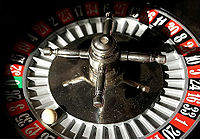
The brawl in a roulette tin can be used as a source of credible randomness, because its beliefs is very sensitive to the initial conditions.
It is generally accustomed that there exist iii mechanisms responsible for (evidently) random beliefs in systems:
- Randomness coming from the environment (for example, Brownian motion, just too hardware random number generators).
- Randomness coming from the initial conditions. This aspect is studied past anarchy theory, and is observed in systems whose behavior is very sensitive to pocket-sized variations in initial conditions (such as pachinko machines and die).
- Randomness intrinsically generated by the system. This is also called pseudorandomness, and is the kind used in pseudo-random number generators. In that location are many algorithms (based on arithmetics or cellular automaton) for generating pseudorandom numbers. The beliefs of the system tin can be adamant past knowing the seed state and the algorithm used. These methods are often quicker than getting "true" randomness from the environment.
The many applications of randomness take led to many unlike methods for generating random data. These methods may vary as to how unpredictable or statistically random they are, and how quickly they tin generate random numbers.
Before the appearance of computational random number generators, generating big amounts of sufficiently random numbers (which is important in statistics) required a lot of work. Results would sometimes exist collected and distributed as random number tables.
Measures and tests
There are many practical measures of randomness for a binary sequence. These include measures based on frequency, discrete transforms, complication, or a mixture of these, such every bit the tests by Kak, Phillips, Yuen, Hopkins, Beth and Dai, Mund, and Marsaglia and Zaman.[25]
Quantum nonlocality has been used to certify the presence of 18-carat or strong grade of randomness in a given string of numbers.[26]
Misconceptions and logical fallacies
Due to an electric defect, the shown input selector of an sound amplifier switches fast and seemingly at random. However, this may follow a scheme which a homo could only recognize after a scientific-style supervision.
Popular perceptions of randomness are frequently mistaken, and are often based on beguiling reasoning or intuitions.
Fallacy: a number is "due"
This statement is, "In a random selection of numbers, since all numbers eventually appear, those that take not come up yet are 'due', and thus more likely to come up upwardly soon." This logic is only correct if applied to a system where numbers that come upwardly are removed from the system, such as when playing cards are drawn and not returned to the deck. In this case, once a jack is removed from the deck, the next draw is less likely to be a jack and more likely to exist some other bill of fare. However, if the jack is returned to the deck, and the deck is thoroughly reshuffled, a jack is every bit likely to be drawn every bit whatever other carte du jour. The same applies in whatsoever other procedure where objects are selected independently, and none are removed after each event, such equally the roll of a die, a coin toss, or most lottery number choice schemes. Truly random processes such as these do non have memory, which makes it incommunicable for past outcomes to affect future outcomes. In fact, there is no finite number of trials that tin can guarantee a success.
Fallacy: a number is "cursed" or "blest"
In a random sequence of numbers, a number may be said to be cursed because information technology has come up less often in the past, and so information technology is thought that information technology will occur less frequently in the futurity. A number may be assumed to be blessed considering it has occurred more ofttimes than others in the by, and so it is thought probable to come more often in the hereafter. This logic is valid only if the randomisation might be biased, for example if a dice is suspected to be loaded then its failure to curlicue enough sixes would be evidence of that loading. If the die is known to exist fair, and then previous rolls can give no indication of future events.
In nature, events rarely occur with a frequency that is known a priori, and so observing outcomes to decide which events are more probable makes sense. However, it is beguiling to apply this logic to systems designed and known to make all outcomes as likely, such as shuffled cards, dice, and roulette wheels.
Fallacy: odds are never dynamic
In the start of a scenario, one might calculate the probability of a certain event. However, as before long as one gains more information most the scenario, one may need to re-calculate the probability accordingly.

In the Monty Hall problem, when the host reveals one door that contains a goat, this provides new information that needs to be factored into the calculation of probabilities.
For example, when being told that a woman has 2 children, one might be interested in knowing if either of them is a daughter, and if yes, what is probability that the other child is also a girl. Considering the two events independently, 1 might expect that the probability that the other child is female is ½ (l%), only by building a probability space illustrating all possible outcomes, one would observe that the probability is actually merely ⅓ (33%).
To be sure, the probability space does illustrate four ways of having these 2 children: boy-boy, girl-boy, boy-girl, and girl-girl. But once it is known that at to the lowest degree one of the children is female, this rules out the male child-male child scenario, leaving simply 3 ways of having the two children: boy-girl, daughter-boy, girl-girl. From this, it can exist seen but ⅓ of these scenarios would have the other child also be a girl[27] (see Boy or girl paradox for more than).
In general, past using a probability space, one is less likely to miss out on possible scenarios, or to neglect the importance of new data. This technique tin be used to provide insights in other situations such every bit the Monty Hall problem, a game show scenario in which a car is subconscious behind one of three doors, and two goats are hidden every bit booby prizes behind the others. Once the contestant has chosen a door, the host opens one of the remaining doors to reveal a goat, eliminating that door every bit an option. With only two doors left (one with the car, the other with another goat), the role player must decide to either go on their decision, or to switch and select the other door. Intuitively, one might think the thespian is choosing betwixt two doors with equal probability, and that the opportunity to choose another door makes no difference. However, an analysis of the probability spaces would reveal that the contestant has received new information, and that changing to the other door would increment their chances of winning.[27]
See as well
- Aleatory
- Chaitin's constant
- Chance (disambiguation)
- Frequency probability
- Indeterminism
- Nonlinear organisation
- Probability interpretations
- Probability theory
- Pseudorandomness
- Random.org—generates random numbers using atmospheric noise
- Sortition
Notes
- ^ Strictly speaking, the frequency of an outcome will converge nearly surely to a anticipated value as the number of trials becomes arbitrarily large. Non-convergence or convergence to a dissimilar value is possible, but has probability goose egg.
References
- ^ The Oxford English language Dictionary defines "random" as "Having no definite aim or purpose; not sent or guided in a particular direction; fabricated, done, occurring, etc., without method or witting pick; haphazard."
- ^ a b "Definition of randomness | Dictionary.com". world wide web.dictionary.com . Retrieved 21 November 2019.
- ^ Tertiary Workshop on Monte Carlo Methods, Jun Liu, Professor of Statistics, Harvard University
- ^ Hans Jürgen Prömel (2005). "Complete Disorder is Impossible: The Mathematical Work of Walter Deuber". Combinatorics, Probability and Computing. Cambridge University Press. fourteen: 3–xvi. doi:10.1017/S0963548304006674. S2CID 37243306.
- ^ Ted.com, (May 2016). The origin of countless conspiracy theories
- ^ a b Cristian Southward. Calude, (2017). "Quantum Randomness: From Practice to Theory and Dorsum" in "The Incomputable Journeys Beyond the Turing Barrier" Editors: Due south. Barry Cooper, Mariya I. Soskova, 169–181, doi:10.1007/978-three-319-43669-2_11.
- ^ Handbook to life in ancient Rome past Lesley Adkins 1998 ISBN 0-19-512332-8 folio 279
- ^ Religions of the ancient world by Sarah Iles Johnston 2004 ISBN 0-674-01517-vii page 370
- ^ Annotated readings in the history of statistics by Herbert Aron David, 2001 ISBN 0-387-98844-0 page 115. Note that the 1866 edition of Venn's book (on Google books) does non include this affiliate.
- ^ Reinert, Knut (2010). "Concept: Types of algorithms" (PDF). Freie Universität Berlin . Retrieved 20 Nov 2019.
- ^ Zeilinger, Anton; Aspelmeyer, Markus; Żukowski, Marek; Brukner, Časlav; Kaltenbaek, Rainer; Paterek, Tomasz; Gröblacher, Simon (Apr 2007). "An experimental test of non-local realism". Nature. 446 (7138): 871–875. arXiv:0704.2529. Bibcode:2007Natur.446..871G. doi:10.1038/nature05677. ISSN 1476-4687. PMID 17443179. S2CID 4412358.
- ^ "Each nucleus decays spontaneously, at random, in accord with the blind workings of gamble." Q for Quantum, John Gribbin
- ^ "Study challenges evolutionary theory that DNA mutations are random". U.C. Davis . Retrieved 12 February 2022.
- ^ Monroe, J. Grey; Srikant, Thanvi; Carbonell-Bejerano, Pablo; Becker, Claude; Lensink, Mariele; Exposito-Alonso, Moises; Klein, Marie; Hildebrandt, Julia; Neumann, Manuela; Kliebenstein, Daniel; Weng, Mao-Lun; Imbert, Eric; Ågren, Jon; Rutter, Matthew T.; Fenster, Charles B.; Weigel, Detlef (February 2022). "Mutation bias reflects natural option in Arabidopsis thaliana". Nature. 602 (7895): 101–105. doi:10.1038/s41586-021-04269-6. ISSN 1476-4687.
- ^ Belfield, Eric J.; Ding, Zhong Jie; Jamieson, Fiona J.C.; Visscher, Anne M.; Zheng, Shao Jian; Mithani, Aziz; Harberd, Nicholas P. (Jan 2018). "Dna mismatch repair preferentially protects genes from mutation". Genome Research. 28 (i): 66–74. doi:10.1101/gr.219303.116.
- ^ Longo, Giuseppe; Montévil, Maël; Kauffman, Stuart (one January 2012). No Entailing Laws, but Enablement in the Evolution of the Biosphere. Proceedings of the 14th Annual Conference Companion on Genetic and Evolutionary Computation. GECCO '12. New York, NY, Usa: ACM. pp. 1379–1392. arXiv:1201.2069. CiteSeerXx.1.1.701.3838. doi:10.1145/2330784.2330946. ISBN9781450311786. S2CID 15609415.
- ^ Longo, Giuseppe; Montévil, Maël (ane Oct 2013). "Extended criticality, phase spaces and enablement in biology". Anarchy, Solitons & Fractals. Emergent Critical Brain Dynamics. 55: 64–79. Bibcode:2013CSF....55...64L. doi:10.1016/j.anarchy.2013.03.008.
- ^ Breathnach, A. S. (1982). "A long-term hypopigmentary effect of thorium-10 on freckled skin". British Journal of Dermatology. 106 (i): 19–25. doi:10.1111/j.1365-2133.1982.tb00897.ten. PMID 7059501. S2CID 72016377.
The distribution of freckles seems entirely random, and not associated with whatever other manifestly punctuate anatomical or physiological feature of skin.
- ^ Martin-Löf, Per (1966). "The definition of random sequences". Information and Control. nine (6): 602–619. doi:ten.1016/S0019-9958(66)80018-9.
- ^ Yongge Wang: Randomness and Complexity. PhD Thesis, 1996. http://webpages.uncc.edu/yonwang/papers/thesis.pdf
- ^ "Are the digits of pi random? researcher may agree the key". Lbl.gov. 23 July 2001. Retrieved 27 July 2012.
- ^ Laszso Barabasi, (2003), Linked, Rich Gets Richer, P81
- ^ Municipal Elections Human action (Ontario, Canada) 1996, c. 32, Sched., south. 62 (3) : "If the recount indicates that ii or more candidates who cannot both or all be declared elected to an function take received the aforementioned number of votes, the clerk shall cull the successful candidate or candidates by lot."
- ^ Reichenbach, Bruce (1990). The Constabulary of Karma: A Philosophical Written report. Palgrave Macmillan UK. p. 121. ISBN978-1-349-11899-1.
- ^ Terry Ritter, Randomness tests: a literature survey. ciphersbyritter.com
- ^ Pironio, Southward.; et al. (2010). "Random Numbers Certified past Bong's Theorem". Nature. 464 (7291): 1021–1024. arXiv:0911.3427. Bibcode:2010Natur.464.1021P. doi:10.1038/nature09008. PMID 20393558. S2CID 4300790.
- ^ a b Johnson, George (eight June 2008). "Playing the Odds". The New York Times.
Further reading
- Randomness by Deborah J. Bennett. Harvard University Press, 1998. ISBN 0-674-10745-4.
- Random Measures, fourth ed. by Olav Kallenberg. Bookish Press, New York, London; Akademie-Verlag, Berlin, 1986. MR0854102.
- The Art of Figurer Programming. Vol. 2: Seminumerical Algorithms, third ed. by Donald E. Knuth. Reading, MA: Addison-Wesley, 1997. ISBN 0-201-89684-ii.
- Fooled by Randomness, 2nd ed. by Nassim Nicholas Taleb. Thomson Texere, 2004. ISBN 1-58799-190-X.
- Exploring Randomness by Gregory Chaitin. Springer-Verlag London, 2001. ISBN 1-85233-417-7.
- Random by Kenneth Chan includes a "Random Scale" for grading the level of randomness.
- The Drunkard'south Walk: How Randomness Rules our Lives past Leonard Mlodinow. Pantheon Books, New York, 2008. ISBN 978-0-375-42404-v.
External links
 | Wikiversity has learning resources about Random |
 | Look up randomness in Wiktionary, the free dictionary. |
 | Wikimedia Commons has media related to Randomness. |
- QuantumLab Quantum random number generator with single photons as interactive experiment.
- HotBits generates random numbers from radioactivity.
- QRBG Quantum Random Bit Generator
- QRNG Fast Quantum Random Bit Generator
- Chaitin: Randomness and Mathematical Proof
- A Pseudorandom Number Sequence Exam Program (Public Domain)
- Dictionary of the History of Ideas: Chance
- Computing a Glimpse of Randomness
- Chance versus Randomness, from the Stanford Encyclopedia of Philosophy
Source: https://en.wikipedia.org/wiki/Randomness
0 Response to "in a randomly generated list of numbers from 0 to 7, what is the chance that each number will occur?"
Post a Comment