Amount of Water to Produce 1lb of Beef
Video
What'due south the beef with water?
Don't take a cow man. Improve your wellness by reducing your h2o footprint.
Footprints can be seen in lots of places — in the sand, in the snow, on the moon, even in our h2o.
Look, in our water?
That's correct, though information technology's not exactly what you think. A h2o footprint is like an environmental or ecological footprint. A water footprint accounts for the water used in the agronomical, packaging and aircraft processes used to produce the food you consume.
And since our employees at Denver Water eat, drink and breathe water (okay, probably just drink, merely y'all become the point) information technology's only natural that water footprints would be a focus in our health program.
Denver H2o's employee wellness plan includes voluntary challenges throughout the year, each one typically lasting three weeks. The challenges have goals such as ditching fast food, drinking more than water and getting more practice.

This calendar month, employees are being challenged to endeavour a plant-based nutrition. It's a nutrition that emphasizes minimally processed foods from plants and includes healthy proteins like nuts, seeds, beans and tofu. It likewise allows for pocket-sized amounts of animal products like fish, lean meat and low-fat dairy.
Limiting the consumption of brute products has many positive health impacts like lowering cholesterol and blood pressure level and helping to prevent chronic diseases.
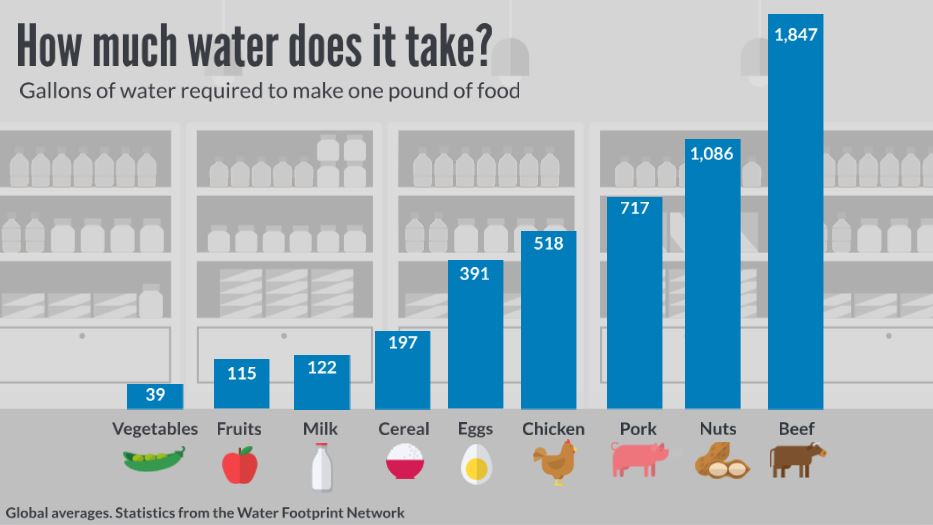
But here'southward where the water footprint comes in. Practice y'all know what food has the largest global water footprint? Beef.
It takes approximately 1,847 gallons of h2o to produce 1 pound of beef — that'southward enough water to fill 39 bathtubs all the way to the tiptop.
For merely 1 pound of beefiness? How can that be possible?
A beefiness cow eats thousands of pounds of grass, corn, grains and soybeans during her lifetime, and water is necessary to grow this diet. That's why the production of animal products like meat, dairy and eggs requires more than water than producing fruits (115 gallons of water per pound) and vegetables (39 gallons of water per pound).
So, when nosotros ask our employees to brand healthier choices when eating, we not only contribute to our employees' overall wellness, but we assistance reduce the global footprint of water. And since we're a water utility dedicated to h2o conservation and efficiency, that's what we phone call a win-win situation.
If yous'd similar to join our employees this month in improving your health and decreasing your global water footprint, here are a few tips:
- Avoid wasting food.
- Reduce the corporeality of processed foods in your diet.
- Limit the corporeality of animal products yous eat and give a plant-based meal a attempt.
- Choose pasture-raised fauna products when you can.
Of course, this isn't for everyone, and eating a burger or steak doesn't mean y'all're wasting water.
But if you lot want to reduce your global h2o footprint with the foods you eat, try reducing your beef intake for a while. You might find it to be a mooooo-ving experience!
And if you want to decrease your water footprint here in Colorado, there are enough of other things you tin can do to employ water efficiently.
Source: https://www.denverwater.org/tap/whats-beef-water
0 Response to "Amount of Water to Produce 1lb of Beef"
Post a Comment