Man Makes Burning Art for Wife Before Falling to Deathoff Cliff
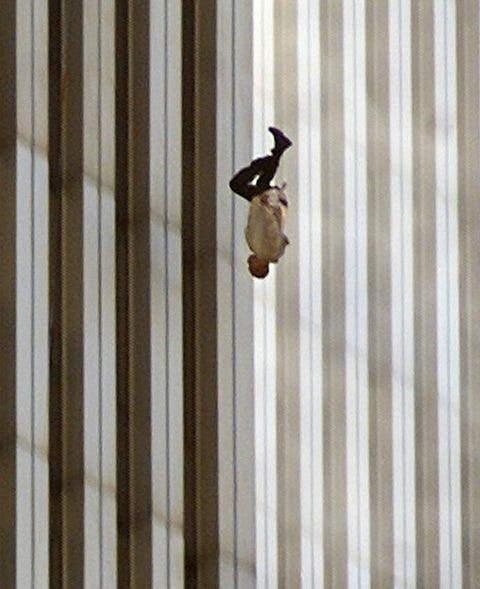
Do y'all remember this photo? In the U.s., people have taken pains to banish information technology from the record of September 11, 2001. The story behind it, though, and the search for the man pictured in information technology, are our well-nigh intimate connexion to the horror of that mean solar day.
Idue north the picture, he departs from this globe like an pointer. Although he has non called his fate, he appears to have, in his last instants of life, embraced it. If he were non falling, he might very well be flight. He appears relaxed, hurtling through the air. He appears comfortable in the grip of unimaginable motion. He does not appear intimidated by gravity's divine suction or by what awaits him. His arms are by his side, only slightly outriggered. His left leg is bent at the genu, almost casually. His white shirt, or jacket, or apron, is billowing free of his black pants. His black high-tops are still on his feet. In all the other pictures, the people who did what he did—who jumped—appear to be struggling against horrific discrepancies of calibration. They are fabricated puny past the properties of the towers, which loom like colossi, then past the result itself. Some of them are shirtless; their shoes fly off as they flail and fall; they await dislocated, as though trying to swim down the side of a mountain. The man in the picture, past contrast, is perfectly vertical, and and then is in accord with the lines of the buildings backside him. He splits them, bisects them: Everything to the left of him in the moving picture is the Due north Tower; everything to the correct, the South. Though oblivious to the geometric residuum he has achieved, he is the essential chemical element in the creation of a new flag, a imprint equanimous entirely of steel bars shining in the sun. Some people who expect at the picture see stoicism, willpower, a portrait of resignation; others run across something else—something discordant and therefore terrible: freedom. At that place is something almost rebellious in the man's posture, as though one time faced with the inevitability of death, he decided to get on with it; as though he were a missile, a spear, bent on attaining his own end. He is, xv seconds past 9:41 a.grand. EST, the moment the picture is taken, in the clutches of pure physics, accelerating at a rate of thirty-two feet per second squared. He will soon be traveling at upwards of 150 miles per hr, and he is upside downwards. In the motion-picture show, he is frozen; in his life outside the frame, he drops and keeps dropping until he disappears.
The photographer is no stranger to history; he knows it is something that happens after. In the actual moment history is made, it is usually made in terror and confusion, and so it is upwardly to people similar him—paid witnesses—to have the presence of heed to nourish to its manufacture. The lensman has that presence of heed and has had it since he was a swain. When he was twenty-one years former, he was standing correct behind Bobby Kennedy when Bobby Kennedy was shot in the caput. His jacket was spattered with Kennedy's claret, merely he jumped on a table and shot pictures of Kennedy's open up and ebbing eyes, and then of Ethel Kennedy crouching over her married man and begging photographers—begging him—not to take pictures.
Richard Drew has never done that. Although he has preserved the jacket patterned with Kennedy'due south claret, he has never not taken a picture, never averted his heart. He works for the Associated Press. He is a journalist. It is not upward to him to pass up the images that fill up his frame, considering 1 never knows when history is made until one makes information technology. It is not even upward to him to distinguish if a body is alive or expressionless, because the camera makes no such distinctions, and he is in the business of shooting bodies, as all photographers are, unless they are Ansel Adams. Indeed, he was shooting bodies on the morning of September eleven, 2001. On assignment for the AP, he was shooting a motherhood way bear witness in Bryant Park, notable, he says, "because it featured actual meaning models." He was fifty-4 years old. He wore glasses. He was thin in the scalp, gray in the beard, difficult in the head. In a lifetime of taking pictures, he has constitute a mode to exist both balmy-mannered and brusque, patient and very, very quick. He was doing what he always does at manner shows—"staking out existent estate"—when a CNN cameraman with an earpiece said that a plane had crashed into the Northward Tower, and Drew's editor rang his cell telephone. He packed his equipment into a bag and gambled on taking the subway downtown. Although information technology was withal running, he was the only i on information technology. He got out at the Chambers Street station and saw that both towers had been turned into smokestacks. Staking out his existent estate, he walked w, to where ambulances were gathering, considering rescue workers "usually won't throw you out." Then he heard people gasping. People on the ground were gasping because people in the building were jumping. He started shooting pictures through a 200mm lens. He was continuing between a cop and an emergency technician, and each time one of them cried, "There goes another," his camera institute a falling body and followed it down for a nine- or twelve-shot sequence. He shot x or fifteen of them before he heard the rumbling of the South Belfry and witnessed, through the winnowing exclusivity of his lens, its collapse. He was engulfed in a mobile ruin, but he grabbed a mask from an ambulance and photographed the peak of the North Belfry "exploding like a mushroom" and raining debris. He discovered that there is such a matter as being too close, and, deciding that he had fulfilled his professional person obligations, Richard Drew joined the throng of ashen humanity heading due north, walking until he reached his office at Rockefeller Heart.
At that place was no terror or defoliation at the Associated Printing. There was, instead, that feeling of history beingness manufactured; although the office was as crowded as he'd ever seen information technology, there was, instead, "the wonderful calm that comes into play when people are actually doing their jobs." And so Drew did his: He inserted the disc from his digital camera into his laptop and recognized, instantly, what only his camera had seen—something iconic in the extended annihilation of a falling human. He didn't expect at any of the other pictures in the sequence; he didn't have to. "Y'all acquire in photo editing to look for the frame," he says. "You lot have to recognize it. That movie just jumped off the screen because of its verticality and symmetry. It just had that look."
He sent the epitome to the AP'south server. The adjacent morning, it appeared on page vii of The New York Times. It appeared in hundreds of newspapers, all over the land, all over the world. The man inside the frame—the Falling Homo—was not identified.
They began jumping not long after the start plane hit the North Belfry, not long afterwards the fire started. They kept jumping until the tower fell. They jumped through windows already cleaved and then, later, through windows they bankrupt themselves. They jumped to escape the smoke and the fire; they jumped when the ceilings savage and the floors collapsed; they jumped just to exhale one time more earlier they died. They jumped continually, from all four sides of the building, and from all floors above and around the building'southward fatal wound. They jumped from the offices of Marsh & McLennan, the insurance company; from the offices of Cantor Fitzgerald, the bond-trading company; from Windows on the Earth, the restaurant on the 106th and 107th floors—the superlative. For more than than an hour and a half, they streamed from the edifice, one after another, consecutively rather than en masse, equally if each private required the sight of some other individual jumping earlier mustering the courage to jump himself or herself. One photograph, taken at a distance, shows people jumping in perfect sequence, like parachutists, forming an arc composed of three plummeting people, evenly spaced. Indeed, there were reports that some tried parachuting, before the force generated by their fall ripped the drapes, the tablecloths, the desperately gathered fabric, from their hands. They were all, evidently, very much live on their fashion down, and their way down lasted an approximate count of ten seconds. They were all, obviously, not just killed when they landed only destroyed, in body though not, ane prays, in soul. One hit a fireman on the ground and killed him; the fireman's body was anointed by Begetter Mychal Approximate, whose own death, shortly thereafter, was embraced as an example of martyrdom later on the photo—the redemptive tableau—of firefighters conveying his body from the rubble made its way around the world.
From the kickoff, the spectacle of doomed people jumping from the upper floors of the Globe Trade Center resisted redemption. They were called "jumpers" or "the jumpers," equally though they represented a new lemminglike grade. The trial that hundreds endured in the building so in the air became its own kind of trial for the thousands watching them from the footing. No one e'er got used to it; no i who saw information technology wished to see it once again, although, of course, many saw information technology once more. Each jumper, no matter how many there were, brought fresh horror, elicited shock, tested the spirit, struck a lasting blow. Those tumbling through the air remained, by all accounts, eerily silent; those on the ground screamed. Information technology was the sight of the jumpers that prompted Rudy Giuliani to say to his police commissioner, "We're in uncharted waters now." It was the sight of the jumpers that prompted a woman to wail, "God! Save their souls! They're jumping! Oh, please God! Relieve their souls!" And it was, at last, the sight of the jumpers that provided the cosmetic to those who insisted on proverb that what they were witnessing was "like a movie," for this was an ending as unimaginable every bit it was unbearable: Americans responding to the worst terrorist attack in the history of the earth with acts of heroism, with acts of cede, with acts of generosity, with acts of martyrdom, and, past terrible necessity, with one prolonged act of—if these words can exist applied to mass murder—mass suicide.
In nigh American Newspapers, the photo that Richard Drew took of the Falling Human ran once and never once more. Papers all over the country, from the Fort Worth Star-Telegram to the Memphis Commercial Appeal to The Denver Postal service, were forced to defend themselves against charges that they exploited a man'southward decease, stripped him of his dignity, invaded his privacy, turned tragedy into leering pornography. Almost letters of complaint stated the obvious: that someone seeing the picture had to know who it was. All the same, fifty-fifty every bit Drew'due south photograph became at once iconic and impermissible, its subject field remained unnamed. An editor at the Toronto Globe and Mail assigned a reporter named Peter Cheney to solve the mystery. Cheney at first despaired of his job; the entire city, later on all, was wallpapered with Kinkoed flyers advertizing the faces of the missing and the lost and the dead. And then he applied himself, sending the digital photograph to a shop that clarified and enhanced it. At present information emerged: It appeared to him that the man was most likely non blackness but dark-skinned, probably Latino. He wore a goatee. And the white shirt billowing from his black pants was not a shirt merely rather appeared to exist a tunic of some sort, the kind of jacket a restaurant worker wears. Windows on the Earth, the eating place at the top of the North Tower, lost seventy-nine of its employees on September eleven, as well every bit xc-one of its patrons. It was likely that the Falling Homo numbered among them. Only which 1 was he? Over dinner, Cheney spent an evening discussing this question with friends, so said goodnight and walked through Times Square. Information technology was after midnight, eight days after the attacks. The missing posters were still everywhere, but Cheney was able to focus on one that seemed to present itself to him—a poster portraying a human being who worked at Windows every bit a pastry chef, who was dressed in a white tunic, who wore a goatee, who was Latino. His proper noun was Norberto Hernandez. He lived in Queens. Cheney took the enhanced print of the Richard Drew photo to the family, in particular to Norberto Hernandez's brother Tino and sister Milagros. They said yes, that was Norberto. Milagros had watched footage of the people jumping on that terrible morn, earlier the television stations stopped showing it. She had seen ane of the jumpers distinguished past the grace of his autumn—by his resemblance to an Olympic diver—and surmised that he had to exist her brother. Now she saw, and she knew. All that remained was for Peter Cheney to confirm the identification with Norberto'due south married woman and his three daughters. They did not desire to talk to him, especially later on Norberto'south remains were found and identified by the stamp of his DNA—a trunk, an arm. So he went to the funeral. He brought his print of Drew's photograph with him and showed it to Jacqueline Hernandez, the oldest of Norberto's 3 daughters. She looked briefly at the film, and so at Cheney, and ordered him to leave.
What Cheney remembers her saying, in her anger, in her offended grief: "That slice of shit is not my male parent."
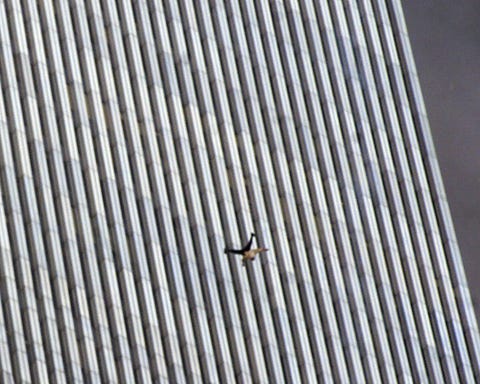
The resistance to the image—to the images—started early, started immediately, started on the ground. A mother whispering to her distraught child a consoling lie: "Perchance they're simply birds, honey." Bill Feehan, second in command at the fire department, chasing a bystander who was panning the jumpers with his video photographic camera, enervating that he turn it off, bellowing, "Don't you lot accept any man decency?" before dying himself when the building came downward. In the most photographed and videotaped day in the history of the world, the images of people jumping were the only images that became, by consensus, taboo—the simply images from which Americans were proud to avert their eyes. All over the world, people saw the human stream debouch from the top of the Due north Belfry, simply here in the U.s.a., we saw these images only until the networks decided not to allow such a harrowing view, out of respect for the families of those so publicly dying. At CNN, the footage was shown live, earlier people working in the newsroom knew what was happening; and so, after what Walter Isaacson, who was then chairman of the network's news agency, calls "agonized discussions" with the "standards guy," information technology was shown simply if people in it were blurred and unidentifiable; then it was not shown at all.
And then it went. In 9/11, the documentary extracted from videotape shot past French brothers Jules and Gedeon Naudet, the filmmakers included a sonic sampling of the booming, rattling explosions the jumpers made upon bear on but edited out the most disturbing affair nearly the sounds: the sheer frequency with which they occurred. In Rudy, the docudrama starring James Woods in the function of Mayor Giuliani, archival footage of the jumpers was beginning included, and so cut out. In Here Is New York, an all-encompassing exhibition of 9/11 images culled from the work of photographers both apprentice and professional, there was, in the department titled "Victims," only one moving picture of the jumpers, taken at a respectful distance; attached to it, on the Here Is New York Web site, a visitor offers this commentary: "This image is what fabricated me glad for censuring [sic] in the countless pursuant media coverage." More than and more, the jumpers—and their images—were relegated to the Internet underbelly, where they became the provenance of the daze sites that also traffic in the autopsy photos of Nicole Dark-brown Simpson and the videotape of Daniel Pearl's execution, and where it is impossible to look at them without attendant feelings of shame and guilt. In a nation of voyeurs, the desire to face the about disturbing aspects of our most disturbing solar day was somehow ascribed to voyeurism, as though the jumpers' feel, instead of being central to the horror, was tangential to it, a sideshow best forgotten.
It was no sideshow. The two well-nigh reputable estimates of the number of people who jumped to their deaths were prepared by The New York Times and Us Today. They differed dramatically. The Times, absolutely conservative, decided to count but what its reporters actually saw in the footage they collected, and it arrived at a effigy of fifty. USA Today, whose editors used bystander accounts and forensic prove in addition to what they found on video, came to the conclusion that at least two hundred people died by jumping—a count that the newspaper said government did not dispute. Both are intolerable estimates of man loss, but if the number provided by USA Today is authentic, then betwixt vii and 8 percent of those who died in New York City on September xi, 2001, died by jumping out of the buildings; it ways that if we consider simply the North Tower, where the vast bulk of jumpers came from, the ratio is more like one in six.
And yet if one calls the New York Medical Examiner's Part to larn its ain approximate of how many people might accept jumped, one does not go an answer but an admonition: "We don't like to say they jumped. They didn't jump. Nobody jumped. They were forced out, or diddled out." And if i Googles the words "how many jumped on nine/xi," one falls into some blogger's trap, slugged "Go Away, No Jumpers Here," where the bait is one'southward own demand to know: "I've got at to the lowest degree three entries in my referrer logs that evidence someone is doing a search on Google for 'how many people jumped from WTC.' My September xi post had made mention of that terrible occurance [sic], and then now whatsoever pervert looking for that will go my site'due south URL. I'yard disgusted. I tried, simply cannot find whatever reason someone would want to know something similar that…. Whatsoever. If that's why you're hither—you're disrepair. Now go away."
Eric Fischl did non go away. Neither did he turn away or avert his eyes. A twelvemonth before September 11, he had taken photographs of a model tumbling effectually on the floor of a studio. He had idea of using the photographs as the ground of a sculpture. Now, though, he had lost a friend who had been trapped on the 106th floor of the Northward Tower. Now, as he worked on his sculpture, he sought to express the extremity of his feelings by making a monument to what he calls the "extremity of choice" faced past the people who jumped. He worked nine months on the larger-than-life bronze he called Tumbling Adult female, and as he transformed a woman tumbling on the floor into a woman tumbling through eternity, he succeeded in transfiguring the very local horror of the jumpers into something universal—in redeeming an paradigm many regarded as irredeemable. Indeed, Tumbling Adult female was mayhap the redemptive prototype of nine/11—and yet it was not merely resisted; information technology was rejected. The twenty-four hour period afterward Tumbling Woman was exhibited in New York'south Rockefeller Eye, Andrea Peyser of the New York Mail service denounced it in a column titled "Shameful Art Attack," in which she argued that Fischl had no right to ambush grieving New Yorkers with the very distillation of their ain sadness … in which she essentially argued the right to look abroad. Considering information technology was based on a model rolling on the floor, the statue was treated every bit an evocation of impact—as a portrayal of literal, rather than figurative, violence.
"I was trying to say something virtually the manner we all feel," Fischl says, "but people thought I was trying to say something about the way they feel—that I was trying to have away something only they possessed. They thought that I was trying to say something about the people they lost. 'That image is not my father. You don't even know my father. How dare you try telling me how I feel near my father?'" Fischl wound up apologizing—"I was ashamed to have added to everyone's hurting"—but it didn't affair.
Jerry Speyer, a trustee of the Museum of Modern Art who runs Rockefeller Center, ended the exhibition of Tumbling Adult female afterward a week. "I pleaded with him not to exercise information technology," Fischl says. "I thought that if we could wait it out, other voices would piping up and carry the day. He said, 'Y'all don't understand. I'g getting bomb threats.' I said, 'People who just lost loved ones to terrorism are non going to bomb somebody.' He said, 'I tin can't have that gamble.'"
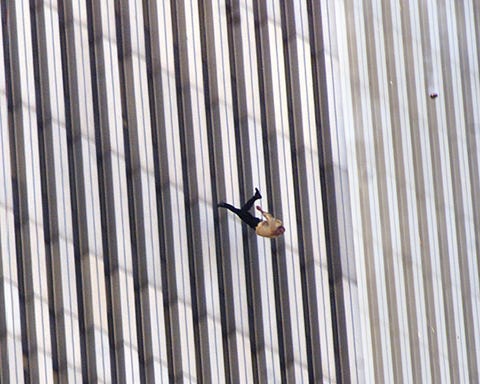
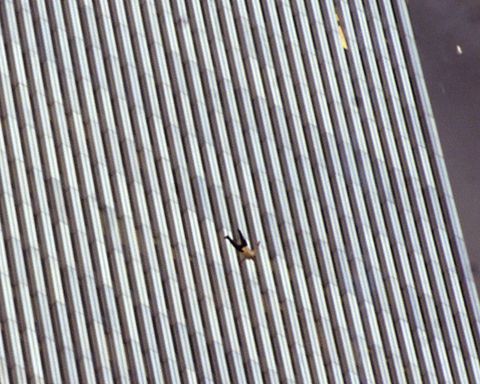
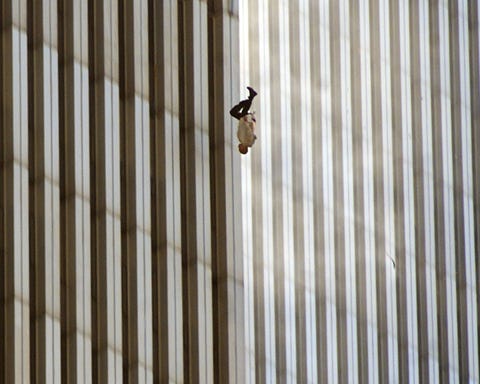
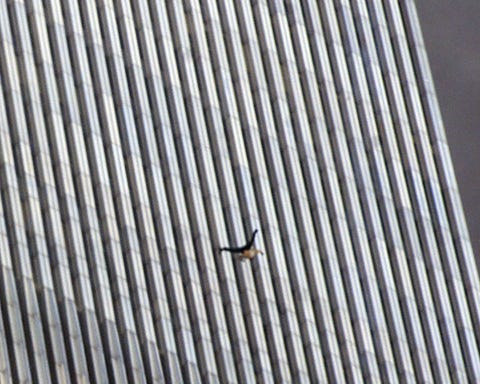
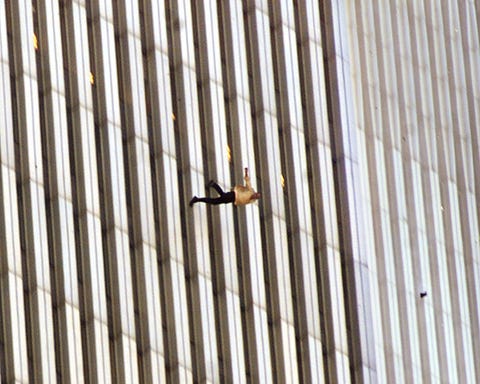
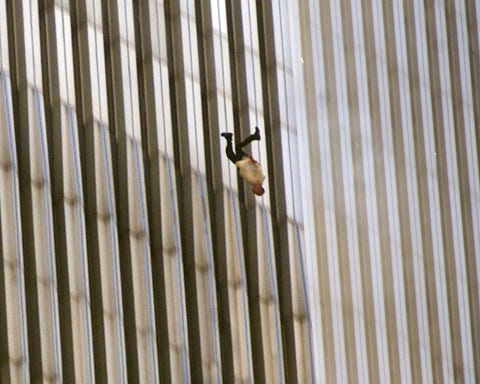
Photographs lie. Even great photographs. Especially not bad photographs. The Falling Man in Richard Drew's picture barbarous in the fashion suggested by the photograph for only a fraction of a 2nd, then kept falling. The photograph functioned as a study of doomed verticality, a fantasia of direct lines, with a man slivered at the eye, similar a spike. In truth, however, the Falling Human being roughshod with neither the precision of an pointer nor the grace of an Olympic diver. He vicious like anybody else, like all the other jumpers—trying to concur on to the life he was leaving, which is to say that he fell desperately, inelegantly. In Drew's famous photograph, his humanity is in accordance with the lines of the buildings. In the rest of the sequence—the eleven outtakes—his humanity stands apart. He is not augmented by aesthetics; he is merely human, and his humanity, startled and in some cases horizontal, obliterates everything else in the frame.
In the complete sequence of photographs, truth is subordinate to the facts that emerge slowly, pitilessly, frame by frame. In the sequence, the Falling Man shows his face to the camera in the two frames before the published i, and after that there is an unveiling, virtually an unpeeling, as the force generated by the fall rips the white jacket off his back. The facts that emerge from the unabridged sequence suggest that the Toronto reporter, Peter Cheney, got some things right in his effort to solve the mystery presented by Drew's published photo. The Falling Man has a dark bandage to his peel and wears a goatee. He is probably a food-service worker. He seems lanky, with the length and narrowness of his face up—like that of a medieval Christ—possibly accentuated by the button of the wind and the pull of gravity. Just 70-ix people died on the morning of September 11 after going to work at Windows on the World. Another twenty-one died while in the employ of Forte Food, a catering service that fed the traders at Cantor Fitzgerald. Many of the dead were Latino, or lite-skinned black men, or Indian, or Arab. Many had dark hair cutting short. Many had mustaches and goatees. Indeed, to anyone trying to figure out the identity of the Falling Man, the few salient characteristics that tin can be discerned in the original series of photographs raise as many possibilities as they exclude. At that place is, however, 1 fact that is decisive. Whoever the Falling Human being may exist, he was wearing a brilliant-orange shirt nether his white top. It is the one inarguable fact that the brute strength of the fall reveals. No ane tin know if the tunic or shirt, open at the back, is existence pulled away from him, or if the fall is simply tearing the white fabric to pieces. But anyone tin come across he is wearing an orange shirt. If they saw these pictures, members of his family would be able to see that he is wearing an orangish shirt. They might even be able to remember if he owned an orange shirt, if he was the kind of guy who would ain an orange shirt, if he wore an orange shirt to piece of work that morning. Surely they would; surely someone would call up what he was wearing when he went to work on the terminal morn of his life.....
But now the Falling Man is falling through more than the bare blue sky. He is falling through the vast spaces of memory and picking up speed.
Neil Levin, Executive Director of the Port Authorization of New York and New Bailiwick of jersey, had breakfast at Windows on the World, on the 106th floor of the Earth Merchandise Heart's N Belfry, on the morning time of September 11. He never came home. His wife, Christy Ferer, won't talk well-nigh any of the particulars of his death. She works for New York mayor Mike Bloomberg every bit the liaison between the mayor'southward function and the ix/11 families and has poured the energy aroused by her grief into her piece of work, which, earlier the commencement anniversary of the attack, called for her to visit television executives and ask them not to employ the about disturbing footage—including the footage of the jumpers—in their memorial broadcasts. She is a close friend of Eric Fischl'due south, equally was her husband, and so when the artist asked, she agreed to take a expect at Tumbling Woman. Information technology, in her words, "hit me in the gut," but she felt that Fischl had the right to create and exhibit it. Now she'due south come to the conclusion that the controversy may have been largely a matter of timing. Maybe information technology was but too before long to show something like that. Later all, not long before her husband died, she traveled with him to Auschwitz, where piles of confiscated eyeglasses and extracted tooth fillings are on exhibit. "They can testify that now," she says. "But that was a long time ago. They couldn't show things similar that so…."
In fact, they did, at least in photographic grade, and the pictures that came out of the death camps of Europe were treated as essential acts of witness, without particular regard to the sensitivities of those who appeared in them or the surviving families of the expressionless. They were shown, as Richard Drew'due south photographs of the freshly assassinated Robert Kennedy were shown. They were shown, equally the photographs of Ethel Kennedy pleading with photographers non to accept photographs were shown. They were shown as the photo of the petty Vietnamese girl running naked subsequently a napalm attack was shown. They were shown as the photograph of Father Mychal Approximate, graphically and unmistakably dead, was shown, and accepted as a kind of testament. They were shown every bit everything is shown, for, like the lens of a camera, history is a force that does non discriminate. What distinguishes the pictures of the jumpers from the pictures that have come before is that we—we Americans—are being asked to discriminate on their behalf. What distinguishes them, historically, is that we, as patriotic Americans, have agreed not to expect at them. Dozens, scores, maybe hundreds of people died by leaping from a called-for edifice, and we have somehow taken information technology upon ourselves to deem their deaths unworthy of witness—considering nosotros take somehow deemed the human activity of witness, in this ane regard, unworthy of us.
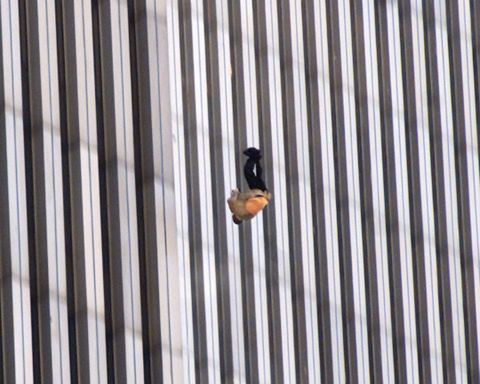
Catherine Hernandez never saw the photo the reporter carried under his arm at her male parent's funeral. Neither did her mother, Eulogia. Her sis Jacqueline did, and her outrage bodacious that the reporter left—was forcibly evicted—earlier he did any more damage. But the pic has followed Catherine and Eulogia and the entire Hernandez family. There was nothing more than important to Norberto Hernandez than family. His motto: "Together Forever." But the Hernandezes are not together anymore. The picture split them. Those who knew, correct away, that the picture was not Norberto—his wife and his daughters—have become estranged from those who pondered the possibility that it was him for the benefit of a reporter's notepad. With Norberto alive, the extended family all lived in the aforementioned neighborhood in Queens. Now Eulogia and her daughters have moved to a house on Long Island because Tatiana—who is now sixteen and who bears a resemblance to Norberto Hernandez: the wide face, the nighttime brows, the thick dark lips, thinly smiling—kept seeing visions of her begetter in the firm and kept hearing the whispered suggestions that he died by jumping out a window.
He could not have died by jumping out a window.
All over the globe, people who read Peter Cheney'south story believe that Norberto died by jumping out a window. People have written poems nigh Norberto jumping out a window. People have called the Hernandezes with offers of coin—either charity or payment for interviews—because they read about Norberto jumping out a window. Simply he couldn't accept jumped out a window, his family knows, because he wouldn't have jumped out a window: non Papi. "He was trying to come dwelling house," Catherine says one morn, in a living room primarily decorated with framed photographs of her father. "He was trying to come habitation to united states of america, and he knew he wasn't going to make it by jumping out a window." She is a lovely, nighttime-skinned, dark-brown-eyed girl, twenty-two years former, dressed in a T-shirt and sweats and sandals. She is sitting on a couch adjacent to her female parent, who is caramel-colored, with coppery pilus tied close to her scalp, and who is wearing a cotton wearing apparel checked with the color of the sky. Eulogia speaks half the time in adamant English, and then, when she gets frustrated with the charge per unit of revelation, pours rapid-burn Spanish into the ear of her girl, who translates. "My mother says she knows that when he died, he was thinking well-nigh us. She says that she could see him thinking about us. I know that sounds strange, but she knew him. They were together since they were fifteen." The Norberto Hernandez Eulogia knew would not have been deterred by smoke or past burn down in his endeavour to come domicile to her. The Norberto Hernandez she knew would have endured whatever pain before he jumped out of a window. When the Norberto Hernandez she knew died, his eyes were fixed on what he saw in his heart—the faces of his married woman and his daughters—and not on the terrible beauty of an empty sky.
How well did she know him? "I dressed him," Eulogia says in English, a smile appearing on her confront at the same time every bit a shiny coat of tears. "Every morning. That morning, I remember. He wore Sometime Navy underwear. Light-green. He wore black socks. He wore blueish pants: jeans. He wore a Casio scout. He wore an One-time Navy shirt. Bluish. With checks." What did he habiliment later she drove him, every bit she ever did, to the subway station and watched him wave to her as he disappeared down the stairs? "He changed clothes at the restaurant," says Catherine, who worked with her father at Windows on the World. "He was a pastry chef, so he wore white pants, or chef's pants—you know, black-and-white check. He wore a white jacket. Under that, he had to vesture a white T-shirt." What well-nigh an orangish shirt? "No," Eulogia says. "My husband did not accept an orange shirt."
There are pictures. There are pictures of the Falling Man as he fell. Practise they desire to see them? Catherine says no, on her female parent's behalf—"My mother should not see"—but then, when she steps exterior and sits down on the steps of the front porch, she says, "Please—show me. Hurry. Before my mother comes." When she sees the twelve-frame sequence, she lets out a gasping, muted call for her mother, but Eulogia is already over her shoulder, reaching for the pictures. She looks at them ane later on some other, and and so her face fixes itself into an expression of triumph and contemptuousness. "That is not my hubby," she says, handing the photographs dorsum. "You see? Only I know Norberto." She reaches for the photographs over again, and then, later studying them, shakes her head with a vehement finality. "The man in this picture is a black man." She asks for copies of the pictures so that she tin show them to the people who believed that Norberto jumped out a window, while Catherine sits on the pace with her palm spread over her middle. "They said my father was going to hell considering he jumped," she says. "On the Internet. They said my father was taken to hell with the devil. I don't know what I would have done if information technology was him. I would accept had a nervous breakdown, I guess. They would have found me in a mental ward somewhere…."
Her mother is standing at the front door, near to get back within her business firm. Her face has already lost its argumentative pride and has turned in one case once more into a mask of composed, almost contemplative sadness. "Delight," she says as she closes the door in a stain of forenoon sunlight. "Please articulate my husband'due south proper noun."
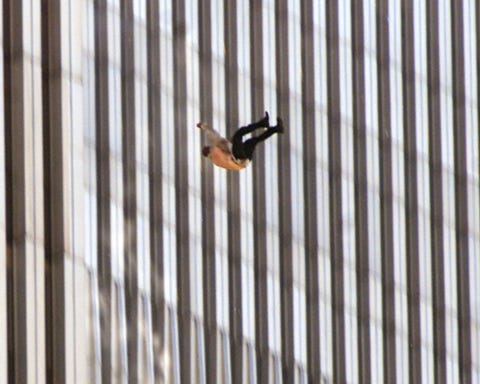
A phone rings in Connecticut. A woman answers. A human on the other end is looking to identify a photo that ran in The New York Times on September 12, 2001. "Tell me what the photo looks like," she says. It's a famous picture show, the man says—the famous moving picture of a human being falling. "Is it the ane chosen 'Swan Swoop' on Rotten.com?" the woman asks. It may be, the human being says. "Aye, that might have been my son," the woman says.
She lost both her sons on September eleven. They worked together at Cantor Fitzgerald. They worked on the equities desk-bound. They worked back-to-dorsum. No, the man on the phone says, the human in the photo is probably a food-service worker. He's wearing a white jacket. He'due south upside down. "And so that's not my son," she says. "My son was wearing a nighttime shirt and khaki pants."
She knows what he was wearing considering of her determination to know what happened to her sons on that solar day—because of her determination to wait and to run into. She did not start with that determination. She stopped reading the newspaper after September 11, stopped watching Tv. Then, on New Year's Eve, she picked up a copy of The New York Times and saw, in a twelvemonth-end review, a picture of Cantor Fitzgerald employees crowding the border of the cliff formed by a dying building. In the posture—the attitude—of ane of them, she idea she recognized the habits of her son. So she called the photographer and asked him to enlarge and clarify the picture. Demanded that he practice it. So she knew, or knew as much every bit information technology was possible to know. Both of her sons were in the picture. 1 was continuing in the window, almost brazenly. The other was sitting inside. She does not need to say what may have happened next.
"The matter I hold was that both of my sons were together," she says, her instantaneous tears lifting her vocalization an octave. "Simply I sometimes wonder how long they knew. They're puzzled, they're uncertain, they're scared—just when did they know? When did the moment come when they lost hope? Maybe it came so quick…."
The human being on the phone does non ask if she thinks her sons jumped. He does not have it in him, and anyway, she has given him an reply.
The Hernandezes looked at the conclusion to bound as a betrayal of love—as something Norberto was existence accused of. The adult female in Connecticut looks at the decision to jump as a loss of promise—every bit an absence that we, the living, now have to live with. She chooses to live with it by looking, by seeing, past trying to know—by making an act of individual witness. She could have chosen to go along her eyes closed. And so at present the man on the phone asks the question that he called to ask in the offset place: Did she make the right option?
"I made the only selection I could have made," the woman answers. "I could never take made the choice non to know."
Catherine Hernandez thought she knew who the Falling Man was every bit soon as she saw the series of pictures, just she wouldn't say his proper noun. "He had a sister who was with him that morning," she said, "and he told his female parent that he would take care of her. He would never accept left her alone past jumping." She did say, however, that the human being was Indian, and so information technology was piece of cake to figure out that his name was Sean Singh. But Sean was as well small to exist the Falling Human being. He was make clean-shaven. He worked at Windows on the World in the audiovisual department, then he probably would have been wearing a shirt and tie instead of a white chef's glaze. None of the sometime Windows employees who were interviewed believe the Falling Man looks anything like Sean Singh.
Besides, he had a sister. He never would take left her alone.
A director at Windows looked at the pictures once and said the Falling Man was Wilder Gomez. Then a few days later he studied them closely and changed his listen. Wrong hair. Incorrect clothes. Wrong body type. Information technology was the aforementioned with Charlie Mauro. It was the same with Junior Jimenez. Junior worked in the kitchen and would accept been wearing checked pants. Charlie worked in purchasing and had no cause to wear a white jacket. Also, Charlie was a very large human. The Falling Homo appears adequately stout in Richard Drew's published photo but near elongated in the rest of the sequence.
The residual of the kitchen workers were, similar Norberto Hernandez, eliminated from consideration by their outfits. The banquet servers may take been wearing white and black, only no one remembered whatsoever banquet server who looked anything like the Falling Man.
Forte Food was the other nutrient-service company that lost people on September xi, 2001. But all of its male employees worked in the kitchen, which means that they wore either checked or white pants. And nobody would accept been allowed to wearable an orange shirt under the white serving coat.
But someone who used to work for Forte remembers a guy who used to come up around and get food for the Cantor executives. Blackness guy. Tall, with a mustache and a goatee. Wore a chef'due south coat, open, with a loud shirt underneath.
Nobody at Cantor remembers anyone like that.
Of course, the simply way to find out the identity of the Falling Man is to phone call the families of anyone who might be the Falling Man and enquire what they know virtually their son's or husband's or father's concluding solar day on earth. Ask if he went to piece of work wearing an orangish shirt.
Just should those calls be made? Should those questions be asked? Would they but heap pain upon the already anguished? Would they be regarded equally an insult to the memory of the dead, the way the Hernandez family unit regarded the imputation that Norberto Hernandez was the Falling Man? Or would they be regarded as steps to some act of redemptive witness?
Jonathan Briley worked at Windows on the World. Some of his coworkers, when they saw Richard Drew'due south photographs, idea he might be the Falling Man. He was a lite-skinned black man. He was over six five. He was twoscore-3. He had a mustache and a goatee and close-cropped hair. He had a married woman named Hillary.
Jonathan Briley'due south father is a preacher, a man who has devoted his whole life to serving the Lord. After September 11, he gathered his family together to ask God to tell him where his son was. No: He demanded it. He used these words: "Lord, I need to know where my son is." For 3 hours straight, he prayed in his deep voice, until he spent the grace he had accumulated over a lifetime in the insistence of his entreatment.
The adjacent day, the FBI chosen. They'd establish his son's body. It was, miraculously, intact.
The preacher'south youngest son, Timothy, went to identify his brother. He recognized him by his shoes: He was wearing black high-tops. Timothy removed one of them and took it abode and put it in his garage, as a kind of memorial.
Timothy knew all well-nigh the Falling Human being. He is a cop in Mount Vernon, New York, and in the calendar week afterward his brother died, someone had left a September 12 newspaper open in the locker room. He saw the photo of the Falling Man and, in acrimony, he refused to look at it once again. But he couldn't throw it away. Instead, he blimp it in the bottom of his locker, where—similar the black shoe in his garage—it became permanent.
Jonathan's sis Gwendolyn knew about the Falling Man, likewise. She saw the movie the mean solar day it was published. She knew that Jonathan had asthma, and in the smoke and the rut would take done annihilation just to breathe….
The both of them, Timothy and Gwendolyn, knew what Jonathan wore to work on most days. He wore a white shirt and black pants, along with the high-elevation blackness shoes. Timothy also knew what Jonathan sometimes wore nether his shirt: an orange T-shirt. Jonathan wore that orange T-shirt everywhere. He wore that shirt all the time. He wore it then often that Timothy used to make fun of him: When are you gonna get rid of that orange T-shirt, Slim?
But when Timothy identified his brother'southward body, none of his dress were recognizable except the black shoes. And when Jonathan went to work on the forenoon of September xi, 2001, he'd left early and kissed his wife goodbye while she was yet sleeping. She never saw the clothes he was wearing. After she learned that he was dead, she packed his apparel away and never inventoried what specific articles of habiliment might exist missing.
Is Jonathan Briley the Falling Man? He might be. But perhaps he didn't leap from the window equally a betrayal of love or because he lost hope. Maybe he jumped to fulfill the terms of a miracle. Maybe he jumped to come home to his family. Peradventure he didn't jump at all, because no 1 can leap into the arms of God.
Oh, no. Y'all have to fall.
Yes, Jonathan Briley might be the Falling Man. Simply the just certainty nosotros have is the certainty we had at the offset: At fifteen seconds after 9:41 a.m., on September 11, 2001, a lensman named Richard Drew took a picture of a human being falling through the sky—falling through time as well as through space. The picture went all around the world, and then disappeared, as if we willed it abroad. I of the most famous photographs in human history became an unmarked grave, and the human being buried within its frame—the Falling Man—became the Unknown Soldier in a war whose end we take not yet seen. Richard Drew'south photograph is all we know of him, and withal all nosotros know of him becomes a measure of what nosotros know of ourselves. The moving-picture show is his cenotaph, and like the monuments dedicated to the memory of unknown soldiers everywhere, information technology asks that we look at it, and make one elementary acknowledgment.
That we have known who the Falling Man is all along.
Additional Reporting past Andrew Chaikivsky.
This content is created and maintained by a tertiary party, and imported onto this folio to help users provide their electronic mail addresses. Yous may be able to find more than information about this and similar content at piano.io
Source: https://www.esquire.com/news-politics/a48031/the-falling-man-tom-junod/
0 Response to "Man Makes Burning Art for Wife Before Falling to Deathoff Cliff"
Post a Comment