Hap Ki Do Korean Art of Self Defense Master H
REVIEW Commodity
GAMA, Uberto Afonso Albuquerque da [i]
GAMA, Uberto Afonso Albuquerque da. Historical synthesis of Korean Hapkido and its contributions. Revista Científica Multidisciplinar Núcleo do Conhecimento. Year. 06, Ed. 09, Vol. 06, p. 153-167. September 2021. ISSN: 2448-0959, Admission link: https://www.nucleodoconhecimento.com.br/education-physics-en/korean-hapkido, DOI: 10.32749/nucleodoconhecimento.com.br/education-physics-en/korean-hapkido
ABSTRACT
The theoretical support assumptions of Hapkido are closely linked to the influences of neighboring Eastern peoples, specially India and Mainland china. The general objective of this article is to present a brief history of this Korean martial art and its founders. The specific objectives are to emphasize the importance of martial techniques in contemporary times and their contribution to the development of human potential. The methodology applied was through a systematic review of authors on the field of study in Brazil, Korea and the United States. The results showed that the oppressions that the Korean people suffered throughout their history were the main reasons why this martial art was structured in a well-organized and complete way. Hapkido has proven its relevance in the growth of peachy nations, in the training of trainers and in the preparation of fighters and combatants in the Armed Forces past promoting and developing discipline, order and social interaction. It is concluded, therefore, that a technical-scientific evaluation is necessary, linking this martial art direct to philosophy, psychology, concrete education and sports medicine, with practical applications for society and for specialized communities on all continents, peculiarly for professionals. of Physical Didactics who will be able to use this gear up of techniques as a training model for their students.
Keywords: Hapkido, Martial Preparation, Discipline, Cocky-esteem, Transformation.
1. INTRODUCTION
The more than educated and educated and the more cultured and prepared a people, the amend their personal and citizenship germination will be. There are many examples of developed and rich countries that grew through education and expanded their progress in a short time. We all know that the positive transformation of a nation takes identify through the education of its people.
It is a fact that the family, the schoolhouse, guild and the authorities must piece of work together offering solutions and implementing constructive actions that result in this. Thus, information technology is necessary to rescue the development of the psychic, motor, intellectual, emotional and spiritual abilities of each individual, developing self-confidence and sensation of guild, discipline, generosity, force, courage, honor and humility – important factors for the progress of a nation ( SHEYA, 2000).
In this way, it can be observed that the teaching of the Korean martial art Hapkido[2] has proved to exist quite effective in transmitting a cooperative spirit, sensation of corporeality and motricity, with ethical principles and companionship with the goal of achieving full citizenship. (LIM, 2017).
The word Hapkido means "harmonic path of free energy". Information technology is an art that tin can be practiced by all people, of all age groups, from the youngest to the oldest individual (GAMA, 2019).
The theoretical support assumptions of the martial art called Hapkido are closely linked to the influences of neighboring Eastern peoples, especially India and Communist china. However, little is known virtually these influences and how Hapkido can contribute to the development of human potential. In this context, the nowadays article has the full general objective of conveying out a cursory history of this Korean martial art and its founders.
According to Amaral (2020), Hapkido has the know-how to develop the recovery process of children and immature people who reveal social beliefs disorders, both in family life and in the schoolhouse unit of measurement, eliminating violence and hostility, and encouraging fraternization, social well-existence and respect amidst all people.
2. HAPKIDO: AN ART OF Force AND DISCIPLINE
Originating in Korea, when the country was not yet divided, Hapkido has go one of the most complete martial arts. It is currently a military subject area taught in the Armed Forces almost all over the world because information technology involves in its practical preparation the formation of ethical, moral, philosophical, technical and psychophysical principles. (MILLER, 2016).
Still, Hapkido is not an ancient martial fine art, as some merits. Hapkido is an art in a continuous process of development and is ready to positively transform all people (SHEYA, 2000). Hapkido is a modern art that was developed in the 20th century around the 1940s. It was influenced in its roots by the concepts of Daito-ryú Aikijujútsu, a traditional Japanese fight transmitted past the Japanese master Sôkáku Takêda and which, in plow, was deeply influenced by Darúma Taíshi, also known as Ta Mô or Boddhidharma[iii] (KIM – KIM, 2005).
Yet, anybody attributes the codification of Hapkido to Master Choi Yong-Sul. He was a student of sensei Takêda and only much afterwards did he reorganize his techniques and strikes, expanding the possibilities of Hapkido (SHAW, 2011).
This transformed Hapkido into a new martial trend, an effect already observed past the intervention of other keen teachers and masters with their own methodologies. His broad and precise view of the techniques showed that Hapkido would become one of the most complete in the globe (PELLEGRINI, 2009).
2.1 A BRIEF SUMMARY OF HISTORY
Co-ordinate to Kimm (2005) in order to have a better understanding of the possible origins of Hapkido and how its evolution was, nosotros must make a brief summary and get back analyzing the twelvemonth 2333 BC. C., possible engagement from the archaeological and historical records of the emergence of Korea.
Due east assim, neste período, o povo daquela época encontrava-se insatisfeito com seu modo de vida eastward começava sua migração gradual para uma vasta região practice lado leste da Ásia due east que atualmente incluiu o extremo nordeste da Cathay eastward que se denominava Manchúria. Este povo estabeleceu-se em uma região muito próspera hoje denominada como península coreana em busca de um melhor clima, terras férteis para agricultura, rios e praias para pesca due east terras de montanhas para caça para sua sociedade e que formou três reinos controlados pela Rainha Chin Heung: Koguryô, Paekchê e Silla (CALDAS, 2011)
During a long menses of migration and stabilization, tribal systems had established that young warriors must exist trained in the practice of the fighting arts empty-handed to protect all members. Subsequently, they should be prepared and technically trained in the use of sticks, staffs, spears and other weapons. This was a very wild and rough time, where only the strongest and most capable survived. The wars between the Mongols and the Chinese were permanent (KIMM, 2005).
Over time, the development of archery was likewise of farthermost relevance linked to equus caballus riding. The start tribes used horses for hunting over long distances and for the defense of society. Gradually, in addition to archery, the utilize of spears, yon-bom[4], knives, daggers and other weapons[five] was included.
Later, the leaders who had greater skills, more technical capabilities, formed an aristocracy group chosen Hwarang-dô. His followers or disciples called themselves Nang-dô (SHAW, 2011). The elite group followed strict rules of conduct and loyalty, both to the king and to friends and relatives, with bravery and boldness that guided their lives.
2.2 DISPUTE BETWEEN NATIONS
The historical understanding of this flow is fundamental in this work, so that we can describe the context where Hapkido had its development and evolution in the function of martial arts.
Japan's interest in Korea gradually increased and the possibility of occupation and colonization was already on the verge of happening. In that location were two wars won past Nihon: the first from 1894 to 1895 between Japan and China; and the second from 1904 to 1905 between Nippon and the Soviet Matrimony. (KIMM, 2005).
After that, Japan increased its presence on the Korean peninsula with the intention of occupation. And that invasion finally took place in 1910, when there was the decline of the Korean Empire. This was due to internal disputes of command which weakened the Kingdoms of Korea.
Ocorreu então a assinatura exercise Tratado de Ganghwa ou também conhecido como "Tratado da Amizade Japão-Coréia", celebrado entre o Império practice Japão e o Reino Joseon em 1876. Neste momento da história, aconteceu um acordo de coalizão entre a Coréia east o Japão. Mais tarde é assinado outro acordo, o Tratado Eulsa, onde o Império Coreano ganhou proteção do Império Nipônico, dando ares de um Estado independente, mas que, na verdade, estava ficando subordinado à política externa e obrigações junto ao Império practice Japão (LIM, 2017).
Korea is then occupied by hundreds of thousands of Japanese people, who transfer their residences to that country, losing their fertile properties, which are and then taken past armed services forcefulness, initiating clashes and disputes betwixt Japanese and Koreans (KIMM, 2005).
In 1930, Koreans were forced to migrate to Japan to perform forced labor. Many other acts against human rights were carried out. And but in 1945, at the cease of World War Two, the Soviet Marriage and the Usa decided to intervene and dissever Korea, with the North being under Soviet rule and the Due south under American rule. The demarcation would be the 38th parallel, a region demarcated by the Russians who were established in the area (SHAW, 2011).
According to Kimm (2005), during the Potsdam conference meeting, betwixt July 17 and August two, 1945, the Soviet Wedlock and the Usa committed to abandoning Korea, leaving two governments: in South korea (Seoul), where Syngman Rhee, an American marry, was established, and in N Korea (Pyongyang), Kim-IL Sung, a Russian marry, was established.
The dictatorial characteristics were harshly imposed and remain to this twenty-four hours with the 38th parallel every bit the edge. Both North and Due south Korean rulers wanted the unification and not the division of the country (GAMA, 2019).
Fifty-fifty though the Potsdam briefing coming together was honored through the signing of the peace treaty, North Korean ruler Kim Il Sung tried to influence Josef Stalin, communist revolutionary and Soviet politician, to invade Republic of korea and seize it. there the force. Stalin was apprehensive for a number of reasons, specially the fact that the conflict would pb to a violent confrontation with the United states of america.
According to Shaw (2011), even so, Josef Stalin agreed to support North Korea influenced by Kim Il Sung. And then, only in 1949, Cathay had become a communist state, and so, Josef Stalin, in lodge to guarantee the support of the Union of Soviet Socialist Republics – USSR – over the Asian region, guaranteed and paid Kim IL Sung to invade Republic of korea. Due south on June 25, 1950, crossing the 38th parallel border. The war machine confrontation betwixt the nations begins.
Faced with this scenario, the United nations Security Council – UN – issued Resolution 83, on June 27, 1950, which authorized foreign intervention to eliminate hostility against Republic of korea past withdrawing its troops, a fact that did non happen. And then, from that, the Us as an ally of Republic of korea, sent thousands of soldiers to back up democracy. American intervention was critical as the North Koreans were on the verge of defeating and taking over Republic of korea. There was an imbalance of forces, that is, USSR and CHINA fought together against Seoul (SHAW, 2011).
According to Pellegrini (2009), the U.s. is at present entering a direct confrontation supporting the Southward Koreans with the intention of guaranteeing democracy in the region.
The and then-called American offensive chosen the Battle of Inchon, on the 38th parallel border, gave strength to the South Koreans and the contrary procedure began once more. But at this moment, Mainland china warned the Us to desist from invading, but notwithstanding, the conflict continued, and North Korean troops were cornered by the US. China then sent thousands of soldiers who invaded the Yalu River and a new phase of the Korean War began (KIMM, 2005).
China became involved in the Korean War, because information technology feared that the N Koreans would be defeated and invade Chinese territory, where Mao Zedong's revolution was all the same taking shape. Furthermore, China was already convinced of the ideology of communism for the whole globe and would not accept defeat (KIMM, 2005).
According to Tedeschi (2006), in the end there was a new moment of meeting and both sides signed a new peace treaty between 1951 and 1953, which established the end of the war, and until today, both Northward and South Koreas, remain divided by rivalry, antagonism and high jealousy, disputing who is the best in front of the world. It is observed that political movements effectually the world have been employed for the conciliation and unification of the Koreas.
Nevertheless, all this made the Korean people able to undertake a new strategic movement using the techniques already known from their country with the techniques of foreign invaders, mixing the arts of war (LIM, 2017).
2.3 THE CODING OF HAPKIDO
The most important and relevant graphic symbol in the history of Hapkido was Master Choi Yong-Sool. Along with him, other great masters besides carried out their coding, establishing a wide range of techniques that include kicks, punches, blocks, rolls, falls in dissimilar ways, combats confronting unlike opponents, meditation, massage, philosophy and therapeutic healing techniques.
Amid these great masters, we also observe Thou Primary John Pellegrini, an Italian-American living in the United States, founder of the International Combat Hapkido Federation; Grand Master Ji-Han Jae, a South Korean based in the United States, founder of the Sim-Moo Hapkido International Federation – and who played opposite the famous Bruce Lee in the movie Game of Death or "Game of Death"; Grand Chief Hui Choe, a South Korean based in California and creator of Kum Moo Kwan Hapkido, and Grand Master Kim Hee Song, inspirer of Vocal Do Kwan, among other celebrities (SHAW, 2011).
At the end of the 50's, the precepts and doctrine of Master Choi Yong-Sool began to have more evidence in Korea because the behavior of his students and disciples was different. All had a lot of courage, decision, strength, disposition, humility and bailiwick. This could be the get-go of the transformation of a nation (MILLER, 2016).
According to Gama (2019), it was only in the early on 1970s that Hapkido arrived in Brazil, with a migration of several Korean masters: in the State of Paraná, main Hee Vocal Kim arrived; in the State of São Paulo with principal Kang Byung Ha; in Cruz das Almas – BA, with the Lim brothers (Jung Do and Jung Duck), among other not bad masters and international instructors, being a gimmicky codification created from the systematization of several other martial arts, with the ethical bases of oriental philosophy, of the codes of conduct and teachings of Zen Buddhism.
Finally, the successful introduction of Hapkido in Brazil was due to two reasons: for its effectiveness in the gainsay used by the Military and for its philosophical character as a fashion of life offering subject, cocky-confidence, organization and positive conclusion (GAMA, 2019) .
According to Caldas (2011), therefore, Hapkido had its historical importance in the reconstruction of Korea forth with other arts of war. And ane of the secrets of the South Korean "phenomenon" was to prioritize didactics as a government policy. And Hapkido is part of this educational procedure. The mindset is to continue the modernization piece of work.
Um dos segredos exercise "milagre" sul-coreano foi priorizar a educação como política de governo. E a mentalidade é continuar o trabalho de modernização. A partir dos anos 1990, após atingir a universalização de um ensino de boa qualidade, o governo do país decidiu realizar uma nova reforma em seu sistema educativo a fim de aproveitar as oportunidades proporcionadas pela sociedade de informação. O objetivo é investir desde as escolas primárias a fim de colocar a sociedade sul-coreana – cuja renda per capita hoje é mais que o dobro da brasileira, mas menos do que um terço da americana – na vanguarda dos próximos avanços tecnológicos (AMARAL, 2012).
Table 1 below presents a list of Martial Arts originating in Korea, with their name, translation and foundation or art codifier.
Tabular array 1 – Martial Arts Originating in Korea
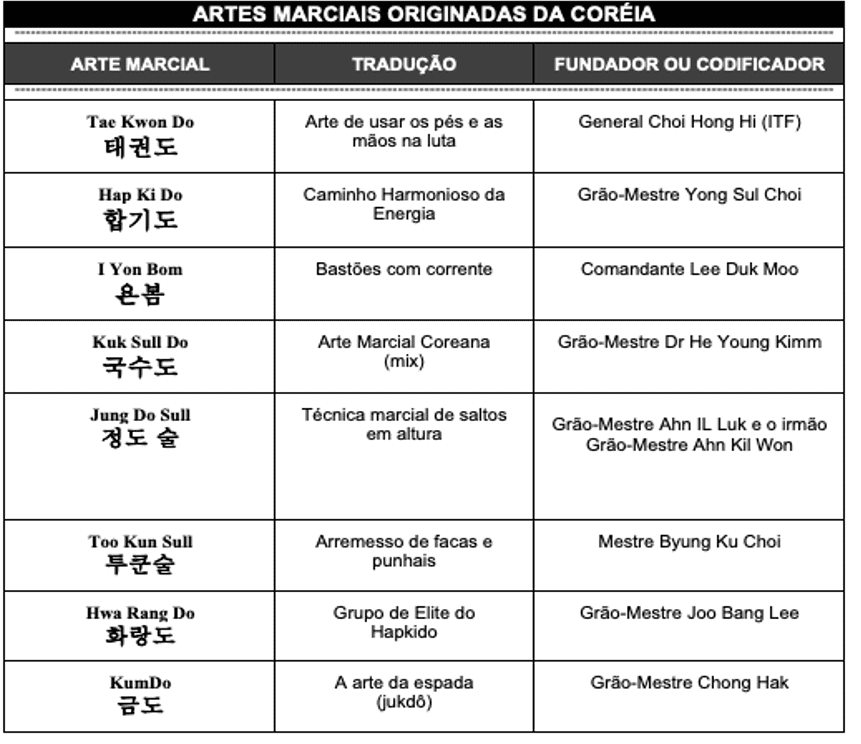
Source: Adapted from Dr. He-Young Kimm, 2005.
2.iv HAPKIDO AND SOCIAL PROJECTS
At some point in history after 1950, over 1,400 sophisticated empty-handed combat systems evolved. Kwon Bop[6], for example, emerged as an umbrella term for empty-handed techniques. Su Bak Exercise and Tae kyon[7] were two fighting systems with an emphasis on low and flying kicks, and Su Sul or Kum Do was a diverse system of sword skills. All these techniques added up were, petty by piffling, existence valued and codified by Kimm (1985) giving the name of Kuk Sull (TEDESCHI, 2006).
Hapkido together with Taekwondo (another Korean art) in plow, were observed and introduced in the Armed Forces of the United States of America, so to other European countries and, finally, they arrived in Brazil, as we could see before in the cursory summary. of the story.
Currently, Hapkido has aroused a lot of interest from several school directors, too as teachers, due to its criteria of discipline, society, hierarchical respect and cordiality (LIM, 2017).
The practice of Hapkido, for example, in some Brazilian schools, has shown articulate progress and a significant comeback of students in behavior and subject, in amount sensation and self-esteem. However, we can still discover that Hapkido is very little publicized in order and with prejudice of some almost this art, mixing it with popular beliefs (GAMA, 2019).
According to Gama (2019), Hapkido is currently being introduced in some land and municipal schools at the initiative of some instructors and teachers. In addition, the aforementioned Korean martial art is being inserted in several educational projects throughout the national territory by the costless initiative of several professionals who work in the recovery of delinquent and marginalized young people and who are adapting very hands to the subject and order imposed by the Korean martial art.
The work with Hapkido in state, municipal and individual schools in the urban center of Curitiba has the specific objective of including the same martial fine art every bit part of the curriculum, however, at first, the activity is offered as an extracurricular activity and inserted after school hours.
Co-ordinate to Kim (2005), pedagogy Hapkido is however something new and dissimilar, because many teachers notwithstanding do not take noesis about how to work this content in their classes or they all the same feel insecure considering they have never had the opportunity to develop this art.
Although the Concrete Education teacher does not have a more complete or comprehensive grooming on Hapkido, information technology is possible to work within the school conformation by inviting a qualified teacher or teacher to give demonstrations of the art.
2.5 HAPKIDO Code OF Ideals AND DISCIPLINE
Information technology is as well observed that Hapkido, as well as other martial arts, has a strict code of ethics and conduct, with disciplines and mentality systematized in unlike degrees aiming at a loftier development of its practitioners, instructors, teachers, masters and grand masters focused on self-defense – Ho Shin Sull – and preparing the practitioner's martial spirit (KIMM, 2005).
According to Kimm (2005), the aboriginal martial arts practitioners followed strict rules of loyalty, both to the king and to their parents and friends, and with bravery in combat, with simplicity and prudence in their modus vivendus, establishing five fundamental precepts of ideals, namely :
- Be loyal to the Rex;
- Exist obedient and respect your parents;
- Exist loyal and honor your friends;
- Never retreat earlier the enemy;
- Acquit out a sensible kill.
Table 2, adapted from Kimm (2005), brings the Code of Ethics, demonstrating the presentation of the table.
Tabular array 2 – Hapkido Honor Lawmaking
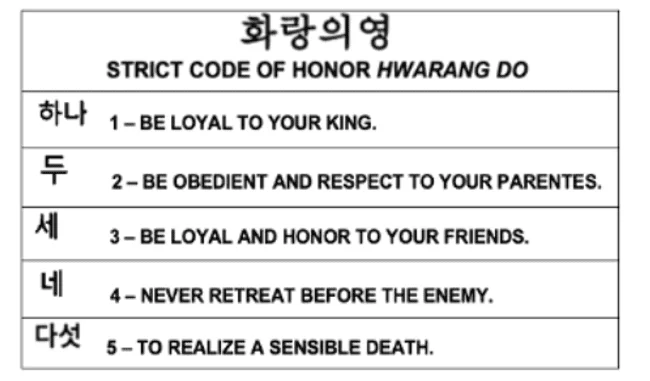
Source: Adapted from Dr. He-Immature Kimm, 2005.
Over fourth dimension, other prescriptions were created as club evolved and became more complex. And Hapkido, being an art of self-defense, requires discipline, order, self-control and hierarchy in the application of its martial and self-defense techniques. Therefore, the code of ideals is mandatory to regulate and keep under control the applicability of its techniques and the conscience of its warriors (GAMA East GAMA, 2019).
3. FINAL CONSIDERATIONS
Amid the limits of the exposed work, the survey of the mentioned literature showed the historical importance of Hapkido and the inclusion of this Korean martial art as 1 of the preponderant foundations in the psychophysiosocial development of social club and its evidence in the development of smashing nations.
The systematization of its techniques and aspects serve as support as an educational tool for the Physical Education professional in preparation children, youth and adults, bringing numerous benefits.
It is pointed out that the general objective of the work was fulfilled, having presented the history of this Korean martial art and its founders. The enquiry of the bibliographic references and the various excerpts commented throughout this article allowed u.s. to recognize more precisely that Hapkido is a useful tool to forge character, develop personality and produce disciplinary order.
It is evident that the role of Hapkido martial art is respectable and significant in the procedure as a rest education for children, youth and adults. Hapkido shows that it can develop high cocky-esteem by not allowing the young person to cower in the face of the immense task of transforming society.
This commodity expands the range of knowledge near the influences on the formation of Hapkido and how it can contribute to the evolution of human potential. The subject of this article is still quite abundant and will need that other colleagues delve into the subject in greater depth. Researchers must adjust to electronic and digital media in the production of scientific articles addressing Hapkido and other martial arts, questioning their impact on earth social club.
Finally, we conclude that a technical-scientific evaluation is needed linking Hapkido and martial arts directly to philosophy, psychology, physical instruction and sports medicine, with practical applications for lodge and specialized communities across continents.
REFERENCES
AMARAL, Rodrigo. Ensino de Qualidade é Segredo do Sucesso na Coréia do Sul. Disponível em: <https://world wide web.bbc.com/portuguese/noticias/2002/020819_educaro3.shtml>. Acesso em 20. Mar. 2020.
CALDAS JR, P. Hapkido: o caminho da energia coordenada. São Paulo: online 2011.
GAMA, U. A. A.; GAMA, M. M. Hapkido Vocal Exercise Kwan – Sistema Filosófico e Marcial. Ed. Vidya, Curitiba, v. 01. 2019.
GAMA, U. A. A.; Hapkido & Taekwondo – O Song Do. Disponível em:< https://www.hapkidocuritiba.com/o-que-east-song-do >. Acesso em 20. Mar. 2020.
GAMA, U. A. A.; Um Breve Perfil Psicanalítico do Bully ou Agressor. Disponível em: < https://www.nucleodoconhecimento.com.br/psicologia/perfil-psicanalitico-exercise-slap-up >. Acesso em 12. Fev. 2020.
LIM, Y. K. Hapkido Martial Arts for Kids and Adults. A. Changkwan Co, South korea, 2017.
MILLER, Yard. The Hapki Manner: The Origins and Usage of Hap and Ki in Hapkido. EUA, Ga Miller Consulting Publishing, 2016.
PELLEGRINI, John. Combat Hapkido: The Martial Art for the Modern Warrior. Florida: Black Chugalug Books Co, 2009.
KIM, G. Y.; KIM, J. Power Hapkido Essential Techniques. New York: Turtle Publishing & Sam Kwang Printing Ltd., 2005.
KIMM, He-Young. Kuk Sool – History of Hapkido. Baton Rouge: Jackson College Press, 2005.
______________. Chul Hak – Philosophy of Kuk Sool. Baton Rouge: Jackson College Press, 2005.
______________. Young-U, Hyul Bub and Lee Ron. Baton Rouge, Louisiana, Jackson Higher Press, 2005.
SHEYA, J. Traditional Hapkido. Florida, U.Due south. Blackness Belt Mag. Publishing, 2000.
SHAW, Scott. Hapkido: Korean Art of Self-Defense – Martial Art. Florida, Turtle Publishing, 2011.
TEDESCHI, Marc. Hapkido: an introduction to the fine art of self-defense. Boston: Weatherhill, London, 2006.
APPENDIX – FOOTNOTE REFERENCE
ii. It is pronounced Hap (as in English Assistance), with an aspirated "H"; Ki-Dô (with circumflex accent simply in pronunciation, not in writing).
three. Boddhidharma (pronounced "bodhidarma"), Indian monk, 28th. Patriarch of Buddhism, founder of Zen or Chinese Ch'An. The name Boddhidharma is equanimous of two words "Boddhi" ( ) meaning "enlightened", and "Dharma" ( ) meaning "law or duty".
4. Yon-bom also known equally "nunchaku", an oriental martial weapon consisting of two small sticks connected by a rope or chain
5. Other weapons that were adult by the Korean people, such as: kung-sa (spear and archery), Kumdô (similar to Kendo), Kisa-Bub (horseback riding), Dan Kum Sool (throwing knives), takyuk sull (techniques fighting and counterattacks), Soo Young Bub (pond and diving), among others.
6. Pronounce "kombô".
7. Pronounce "subakdô" and "tekion".
[1] Honorary Doctor of Physical Education from Cambridge International University; Master in Neuropsychoanalysis; MBA in Sports Administration; Specialist in Psychoanalysis in the expanse of health and social welfare; Specialist in Developmental Psychology; Degree in Philosophy; Physical Education Professional CREF 14.394-G/PR; Bachelor in theology; Journalist MTB 10645/DF.
Sent: June, 2021.
Approved: September, 2021.
Source: https://www.nucleodoconhecimento.com.br/education-physics-en/korean-hapkido
0 Response to "Hap Ki Do Korean Art of Self Defense Master H"
Post a Comment